If you’re sourcing replacement tractor wheel rims, the steel vs alloy agricultural rims debate comes down to one question: what does your machine actually do all day? There is no single best material. The right choice depends on your horsepower, your terrain, and whether you spend more time on a loader bucket or a highway.
This guide breaks down the real differences in weight, durability, corrosion resistance, and total cost — so you can stop guessing and order the right part the first time. If you’re not sure how to measure your current rim, start with our How to Measure a Tractor Rim Guide first — the tire sidewall numbers are only half the answer.
What’s the actual difference between steel and alloy rims?
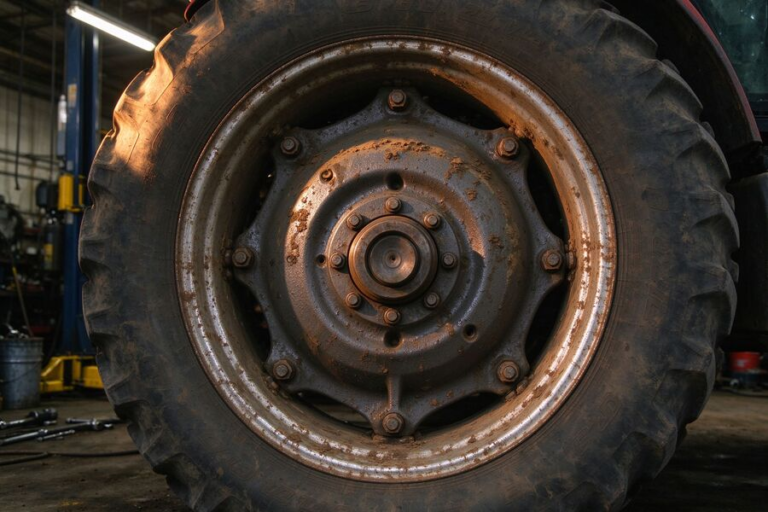
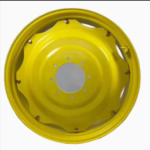
Steel rims are stamped from flat steel sheet and welded together. They’re the black “steelies” you see on most new tractors from the factory.
Alloy rims are cast (or forged) from aluminum mixed with small amounts of silicon, magnesium, and other metals. Pure aluminum is too soft on its own — the added elements give it structural strength.
| Steel rim | Alloy (aluminum) rim | |
|---|---|---|
| How it’s made | Stamped, welded, machined | Cast or forged in a mold |
| Typical finish | Painted black | Polished, machined, or painted |
| Style options | Limited (functional) | Many designs and colors |
| Upfront cost | Lower | Higher |
Steel bends. Alloy cracks.
This is the most important difference in failure mode, and almost no one talks about it.
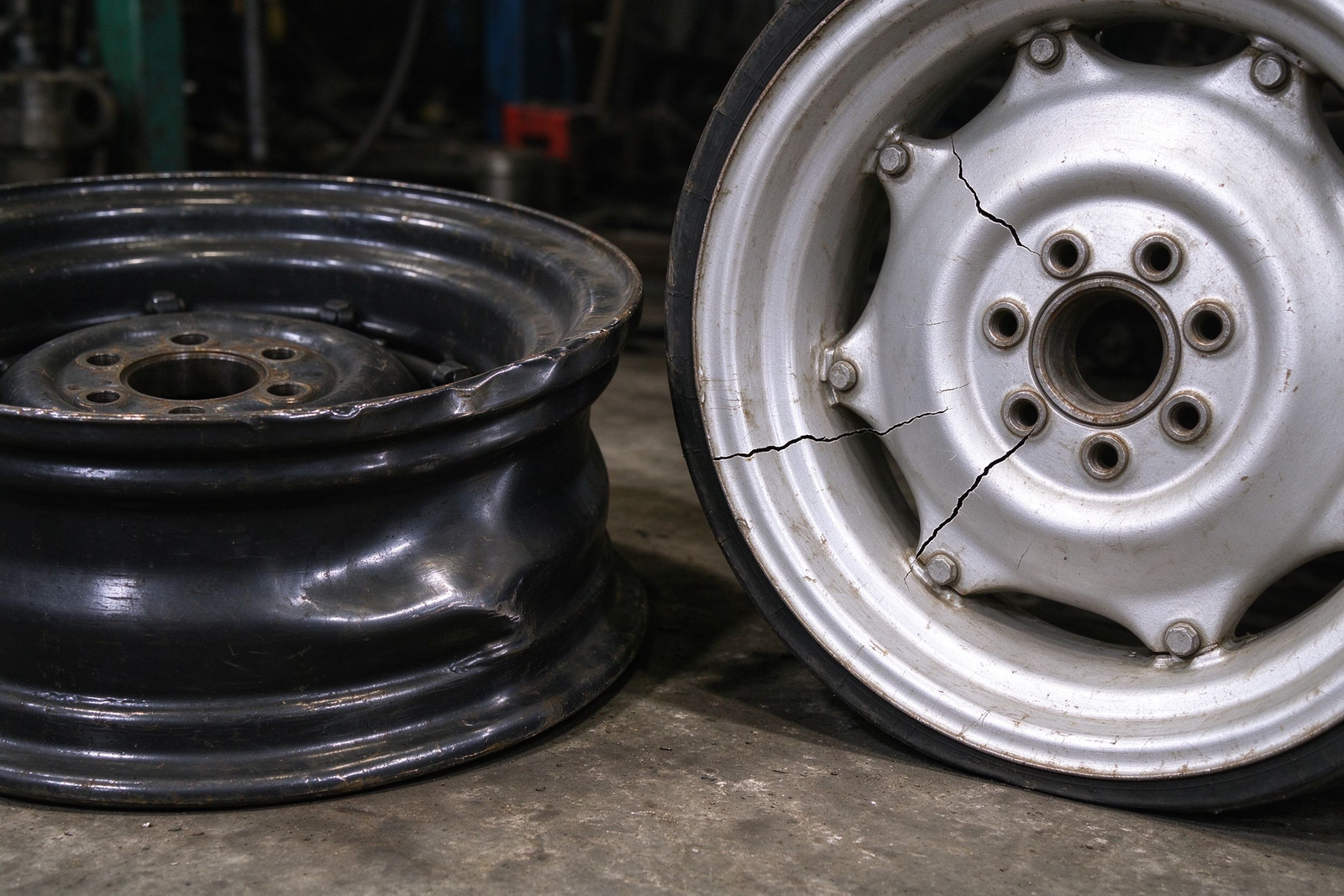
Under impact, steel deforms. It bends. It dents. It flexes — but it usually does not crack. A bent flange can sometimes be pressed back into spec at a local shop.
Under impact, aluminum is brittle. Instead of bending, it can crack. Once an alloy rim cracks, it cannot be repaired — it has to be replaced.
This is why construction, mining, and front-loader work still defaults to steel. Hitting a rock or a stump hard enough to bend a steel rim costs you a repair bill. Hitting it hard enough to crack an alloy rim costs you the whole wheel.
Side-by-side comparison
| Factor | Steel agricultural rim | Alloy agricultural rim |
|---|---|---|
| Weight (16″ rear) | 55–75 lbs | 28–42 lbs (≈40–50% lighter) |
| Load rating | Very high | Moderate — check the spec |
| Impact behavior | Bends, often repairable | Cracks, must replace |
| Heat dissipation | Average | Better — reduces brake fade |
| Rust resistance | Rusts if coating fails | Naturally corrosion-resistant |
| Ballast compatibility | Needs intact inner coating (CaCl₂ eats steel) | Safe with most ballast fluids |
| Typical US price (2026) | $120–$280 | $280–$600 |
| Best for | Loaders, feedlots, high-HP rear | Compact tractors, row crop, road miles |

What does 40 lbs per wheel actually do for your farm?
The weight savings is the #1 reason buyers consider alloy. Here’s what it means in practice.
- Less fuel burned. Industry tests show lighter wheels improve fuel economy by roughly 1–5%, because rotational mass matters more than static weight — roughly 5 lbs of wheel weight equals 25–50 lbs of sprung weight in engine load.
- Longer tire life. Less unsprung weight (the mass not supported by your suspension) means less shock load on the tire sidewall and casing.
- Less soil compaction. On a compact or orchard tractor, every pound off the rim reduces ground pressure.
- More payload. Every pound saved per wheel is a pound you can carry in the loader or on the implement.
For a row-crop tractor covering 10,000+ miles a season, that fuel and tire savings adds up. For a 25 HP compact that barely leaves the shed, it doesn’t.
The hidden cost: total cost of ownership
The sticker price is not the whole story. Steel is cheaper to buy, but alloy can pay back over time.
Where steel wins on cost:
- Buy price is 30–50% lower
- A bent rim can be repaired for $50–$150
- Replacement steel rims are stocked at every local dealer
Where alloy wins over 5 years:
- Lower fuel bills
- Longer tire life (reduced unsprung shock)
- No rust repair, no repainting
- Better resale value on a used tractor
A reasonable rule of thumb: if your tractor puts on serious road miles or runs liquid ballast inside the tires, the alloy premium can pay for itself in 2–3 seasons. If it sits in a barn and does light yard work, steel wins on pure economics.
What about ballast and rust?
Here’s a detail that trips up a lot of first-time buyers.
Most Midwestern farms fill rear tires with calcium chloride (CaCl₂) liquid ballast for traction. It’s cheap and heavy (11 lbs/gallon). The problem: calcium chloride is highly corrosive to steel.
- On a steel rim, a slow leak lets the salt sit against the inner bead seat and rust the rim from the inside out. By the time you see red rust on the outside, the bead seat may already be structurally weakened.
- On an aluminum rim, CaCl₂ does not cause the same kind of corrosion.
If you run CaCl₂ ballast on steel rims, inspect the inner bead seat annually. Better yet, switch to a non-corrosive ballast like beet juice / RV antifreeze.
So which should you buy?
Match the rim to the job:
| Your operation | Pick | Why |
|---|---|---|
| Front loader, feedlot, manure hauling, repeated impact | Steel | Bends instead of cracks, repairable |
| 150+ HP tractor running liquid ballast | Steel (with fresh inner coating) or alloy | Ballast corrosion kills uncoated steel |
| Compact / sub-compact tractor, orchard, lawn | Alloy | Weight savings reduces soil compaction |
| Row crop tractor logging serious road miles | Alloy | Fuel + tire savings over time |
| Budget rebuild or used tractor | Steel | Cheap, repairable, easy to source |
What to ask your rim manufacturer
When you’re comparing quotes for steel vs alloy agricultural rims, don’t just compare the price. Ask these four things:
- What steel grade? — Rim steel is not all the same. Ask for the spec (e.g., rolled hot-rolled steel vs. cold-rolled).
- How is it welded? — The disc-to-rim seam is where rims fail. Single vs. double-sided welding matters.
- What is the certified load rating? — Don’t trust marketing numbers. Ask for the load rating per rim at your tire pressure.
- Is the inner surface coated for ballast? — If you run CaCl₂, an uncoated steel rim will rust out in 2–3 seasons.
These questions separate a real manufacturer from a reseller.
FAQ
Are alloy rims good for tractors? Yes — for the right application. They shine on compact and row-crop tractors where weight savings helps. Skip them on front-loader work or any machine that takes repeated hard impacts.
Do steel rims rust? Yes, especially if you run calcium chloride ballast. Inspect the inner bead seat every season and touch up any chips in the coating.
How much lighter are alloy rims? Typically 40–50% lighter than the equivalent steel rim. On a 16″ rear wheel, that’s roughly 30 lbs saved per corner.
Can I convert from steel to alloy? Yes, but you must match three things: bolt pattern (lug count × PCD), center bore diameter, and offset. Some conversions also require sleeve lug nuts.
Which lasts longer? Steel, when cared for. A coated steel rim in moderate use can last 20+ years. Aluminum doesn’t rust but can crack on impact and is not repairable.
Need help picking? Send us your tire size and tractor model, and we’ll recommend the right rim — steel or alloy — for your specific operation. [Contact our team]