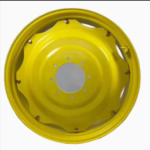
Ordering the wrong tractor rim is expensive. It does not fit the tire. It does not bolt to the hub. And you lose a day in the field paying shipping both ways.
Most mistakes come down to one thing: people measure the wrong spot. As Modern Tire Dealer says, rim width is “bead-seat-to-bead-seat.” It is not the outside edge-to-edge width most people measure.
This guide walks you through the six numbers every farm mechanic uses. It is based on industry-standard measuring methods from tire manufacturers and equipment dealers, not guesswork.
Step 1 — Read the tire sidewall first
Before you touch a tape measure, look at the tire sidewall. The number printed there already tells you the rim diameter.
Tractor tires come in three common formats:
Two-number (bias-ply): 14.9-24. First number is tire width in inches. Second is the rim diameter the tire is designed to fit.
Three-number (compact / lawn): 18×8.50-8. Overall tire height × tire width × rim diameter.
Metric (radial): 520/85R42. Section width in millimeters, aspect ratio, R = radial, last number = rim diameter in inches.
The last number is the one you need. A tire marked 18.4-38 mounts on a 38-inch diameter rim. That diameter must match exactly. A half-inch mismatch can stop the tire bead from seating. It can also cause an explosive separation at operating pressure.
Step 2 — Measure rim width
Here is the mistake almost everyone makes: they measure the rim from outside flange to outside flange. That includes the two raised lips (flanges) that hold the tire bead.
As MOTOR Magazine and Modern Tire Dealer both state, rim width is measured between bead seats.It is measured from the inner face of one bead seat to the inner face of the other bead seat. A rim named “7-inch wide” can actually measure close to 8 inches across its outer flanges. That extra inch is not part of the width spec.
Do it this way:
- Lay a straightedge across one bead lip.
- 2. Measure downto the opposite bead lip.
- 3. Ignore the flanges. You are measuring the channel the tire bead sits in.
Pro tip: Flip the rim over. Most factories stamp the size directly on the inner bead flange. You will see a code like

Step 3 — Understand the rim stamp: what W12×24 actually means
Agricultural rim manufacturers follow a naming convention standardized across Michelin, Trelleborg and Goodyear farm tire catalogs:
W = standard-width rim (from the German “Weite,” or width).
DW = wide-drop-center rim (used on higher-horsepower row-crop tractors).
First number = bead-seat width in inches.
Number after × = rim diameter in inches.
So a stamped W12×24 means: 12-inch bead-seat width, 24-inch diameter. A DW14L×38 is a 14-inch wide drop-center rim on a 38-inch diameter, built for tubeless high-horsepower tires.
If you can read that stamp, you can stop measuring width and diameter right here.
Step 4 — Measure the bolt pattern (PCD)
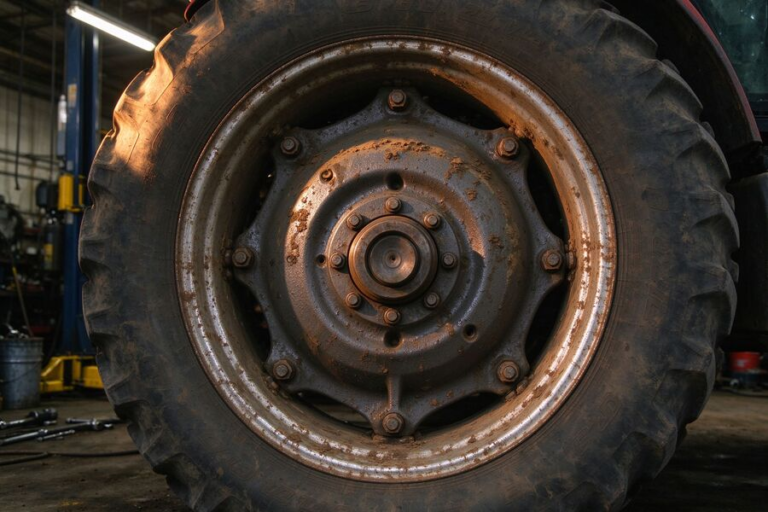
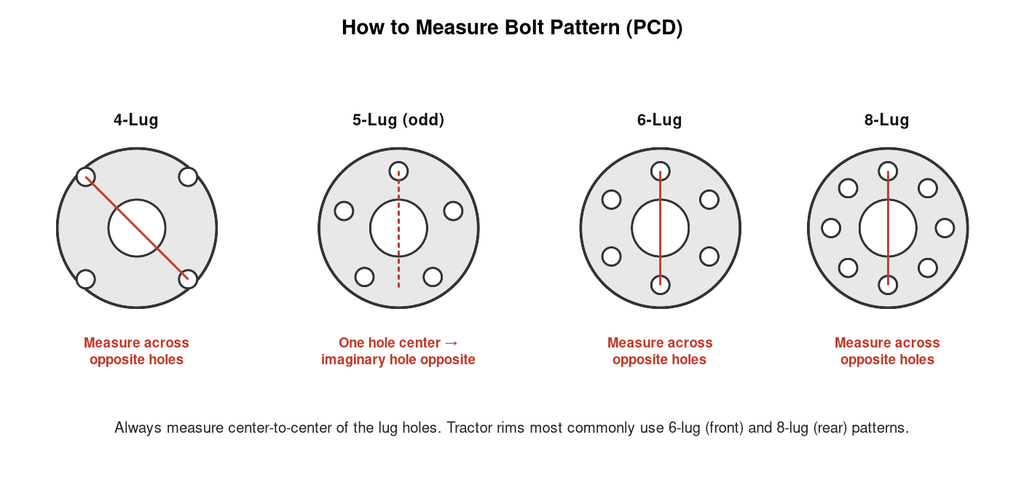
The bolt pattern is the circle formed by the lug holes around the center. It is written as number of holes × bolt circle diameter in inches, for example 8 × 10.5.
How to do it:
- Count the holes. Compact tractor fronts are usually 4- or 6-lug. Mid-size tractor fronts are commonly 6-lug. Rear drive wheels on utility and row-crop tractors are almost always 6- or 8-lug.
- Even number of holes (4, 6, 8): measure straight across from the center of one hole to the center of the hole directly opposite.
- Odd number of holes (5-lug, less common on ag tractors): measure from the center of one hole to the back edge of the hole opposite it. This gets you within 1–2 mm, which is close enough.
Measure the lug hole diameter itself with a caliper if you have one — lug bolts are sized in metric (M14, M16, M18, M20) and a sloppy hole stretches over time.
Real-world examples from ag wheel suppliers: a Case IH 10″W×42″ spun disc uses an 8-hole, 8.0-inch bolt circle with a 6.0-inch pilot bore. A Ford/New Holland 12×24 rear rim uses 6 lugs with a 20-inch center-to-center across the lug circle. These are not interchangeable even though both are rear rims.
Step 5 — Measure the center bore
That large hole in the middle is the center bore (also called pilot bore). It locates the rim on the hub so the lug bolts do not carry the centering load.
Measure it across the center with a tape. If the center bore is too small, the rim will not slide on. If it is too large, the rim runs out of true — you will feel a wobble at road speed, and the lug bolts will fatigue and break.
Two rims with the same bolt pattern but different center bores are not interchangeable without a hub-centric adapter ring.
Step 6 — Measure wheel offset
Offset is how far the hub mounting face sits from the centerline of the rim. The U.S. standards body SAE and wheel engineering references define it the same way: it is the distance from the wheel’s true centerline to the flat disc where the lug bolts clamp.
- Zero offset: mounting face is dead center.
- Positive offset: mounting face moves toward the outside. Rim sits closer to the tractor.
- Negative offset: mounting face moves inward. Rim sticks out farther from the axle, widening the track.
How to measure: lay the rim face-up. Find the centerline of the rim width. Measure down from the top edge to the flat disc where the lug holes are. The distance between centerline and that disc is your offset.

Get this wrong and you will rub the fender, overload the hub bearings, or throw steering geometry off. On a front-drive tractor, a wrong offset is a rollover risk on slopes.
Quick reference: what rim width fits common tractor tires
Tire manufacturers publish recommended rim-width ranges. As a rule of thumb, the recommended rim sits roughly 1–3 inches narrower than the nominal tire width, but always confirm against the tire maker’s chart.
| Tire size | Recommended rim | Rim diameter | Common tractor class |
|---|---|---|---|
| 9.5-24 | W7–W8 | 24″ | Sub-compact / utility |
| 11.2-24 | W8 | 24″ | 30–45 HP |
| 12.4-24 | W9–W11 | 24″ | 45–65 HP |
| 14.9-24 | W10–W12 | 24″ | 55–80 HP |
| 16.9-30 | W12–W14 | 30″ | 80–110 HP |
| 18.4-38 | W14–W16 | 38″ | 120–175 HP |
| 20.8-42 | W16–W18 | 42″ | 180–250 HP |
| 23×8.5-12 | W7–W8 | 12″ | Sub-compact / lawn |
Source: Michelin Agriculture and Trelleborg agricultural rim recommendation tables. Always cross-check with your specific tire brand.
One more check: tubed (TT) vs tubeless (TL)
Before you order, look at the tire sidewall for two letters: TT (tube type) or TL (tubeless).
- TT tires require an inner tube. They can run on either a smooth tube-type rim or a tubeless rim.
- TL tires seal directly against the rim bead seat. They require a rim with a sealed valve stem hole and a smooth bead seat — running a tubeless tire on a rough, corroded tube-type rim will leak.
On the rim itself, tubeless rims have a raised, smooth bead area and a rubber valve stem clamped into a machined hole. Tube-type rims often have a simpler, droppable center and a rubber valve that simply passes through a hole.
A practical rule: if you are replacing just the rim on an older tractor that already runs tubes, staying tube-type is the lowest-risk choic
FAQ
My rim is bent. Can I bend it back?
Only if the bend is on the outer flange and the bead seat is still smooth and true. Cracks near the disc-to-rim weld, or lateral runout over 1/8 inch, mean the rim must be replaced.
Are tractor rims universal?
No. Even when the bolt pattern matches (for example, 8 lugs on a 10.5-inch circle across several mid-size brands), the center bore, offset, and load rating usually differ. Match all five numbers — diameter, width, bolt pattern, center bore, offset.
Can I use a wider rim than the tire recommends?
Tire manufacturers publish an approved rim-width range, usually ±1–2 inches from the recommended width. Going outside that range bulges the tire sidewall, wears the shoulders unevenly, and can drop the load rating.
How do I read the stamped numbers on my old rim?
Agricultural rims use a W[width]×[diameter] format, such as W12×24 or DW14L×38. W means standard-width, DW means wide drop-center. The last number is always the rim diameter in inches.
What is the most common rear lug count on farm tractors?
Mid-size and row-crop utility tractors most commonly use 6-lug or 8-lug rear wheels. Compact and sub-compact tractors typically use 4-lug or 6-lug. Always count your own — model years vary.