


A tractor wheel rim (tractor hub or rim) is the key load-bearing part that connects the tire to the tractor drive or steering axle. It decides whether the tire fits correctly, and it directly affects load distribution, handling stability, tire wear and field working efficiency. Our factory focuses on forged steel wheel rims and supports customization based on your parameters, covering small tractors up to high-horsepower models.
1. Basic Structure of a Tractor Rim
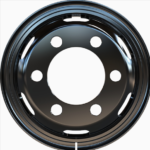
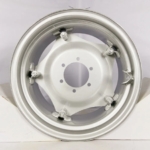
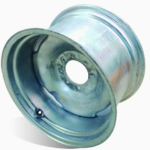
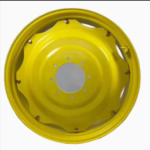
A complete tractor rim usually consists of the following parts:
- Rim: the annular metal part that holds the tire bead. Common types include drop-center, flat-base and split (two-piece) rims.
- Disc plate (web): the round plate connecting the rim barrel to the hub; it carries and transfers torque and axle force.
- Hub bore (center hole): the round opening that fits over the tractor hub spigot.
- Bolt holes (PCD): the holes that fasten the rim to the hub with studs. The number, pitch circle diameter (PCD) and seat type (taper / flat / ball) must match the hub.
- Offset (ET): the distance between the rim centerline and the mounting face. It affects wheel track, steering angle and bearing load.
First step in sizing: check the marking on the rim. For example, “W10×28” means rim width 10 in, diameter 28 in; “10×Ø32” means 10 bolt holes with 32 mm diameter.
If you are looking for a rim for your horsepower range, browse our tractor wheel rim product list or contact us directly for a custom build.
2. Our Forged Steel Rim Process
Most of our products are forged steel rims, which differ from traditional pressed-and-welded rims:
- One-piece forging: the rim barrel and disc are forged together, avoiding weak weld seams. Impact and fatigue resistance are clearly higher than welded parts.
- Dense material: the forged grain structure stays continuous, giving both strength and toughness for high-horsepower tractors, heavy loads and rough field conditions.
- Precise machining: bolt holes, mounting face and hub bore are machined after forging, so dimensional tolerances stay stable and the fit to the hub is reliable.
- Surface finish: phosphating / shot blasting followed by powder coating or e-coating, to resist damp fields and fertilizer / chemical corrosion.
3. How to Order a Custom Rim: What to Provide
We support custom rims based on either your parameters or your drawings. Please provide one of the following before ordering:
Option A: provide parameters directly
| Item | Description | Example |
| Rim size / model | Rim width × diameter (inches) | 22.5 × 24 |
| Bolt holes | Number × hole size, and seat type | 10-Ø32 EQS |
| Hub bore | Center bore diameter | Ø281 mm |
| Offset | Mounting face vs. rim centerline | -50 mm |
| Tire fitment | Tire model you will mount | 18.4-38 |
Option B: provide an engineering drawing. If you already have a CAD drawing with dimensions, tolerances and GD&T, just send it to us and we produce to print.
4. Key Sizing Points
When selecting a rim, all of the following must match. If even one is wrong, the rim will not fit or will fail early:
| Parameter | Description | Common Mistake |
| Rim diameter × width | Must match the “approved rim” marked on the tire | Wrong width causes poor bead seating and air leakage |
| PCD and bolt holes | Hole count, PCD, seat taper | Wrong PCD or taper shears off studs |
| Hub bore | Must be ≥ hub spigot diameter | Too small cannot fit; too large causes runout |
| Offset (ET) | Affects track and steering | Wrong offset hits fenders or overloads bearings |
| Load rating | Single-tire load × 2 ≥ actual axle load | Overloading causes early cracking or ovality |
| Lock ring type | Ring, base ring and lock ring must match | Wrong lock ring can blow the tire off |
When replacing an original rim, start from our tractor wheel rim product list and match the stamped marking. If you need wider track or a different offset, contact us for a custom calculation.
5. Common Problems and Maintenance
- Worn / oval bolt holes: usually caused by uneven tightening or wrong seat taper. Re-torque in a star pattern and check the holes regularly.
- Out-of-round rim: caused by impact or overload; it makes the tire wobble and leak. Check radial runout with a dial indicator and replace if out of spec.
- Cracked forged rim: forged rims have no weld, but a severe impact can still cause a crack. Never weld and reuse under load; replace the whole rim.
- Rust / peeling coating: fields are damp and fertilizer is corrosive. Inspect the paint every season and touch up small spots.
- Lock ring coming loose: for split rims, always fully deflate before removing the lock ring. Never pry on a pressurized tire.
6. Closing
A tractor rim is a small part, but it sits between the tire, the axle and whole-machine stability. Our factory mainly uses forging and supports custom rims from your parameters or drawings, covering different horsepower ranges, bolt patterns and offsets.
To choose or customize, visit our tractor wheel rim product list for standard sizes, or send us your rim size, bolt hole count and diameter, hub bore and offset directly.


Hi, this is a comment.
To get started with moderating, editing, and deleting comments, please visit the Comments screen in the dashboard.
Commenter avatars come from Gravatar.