






Overview
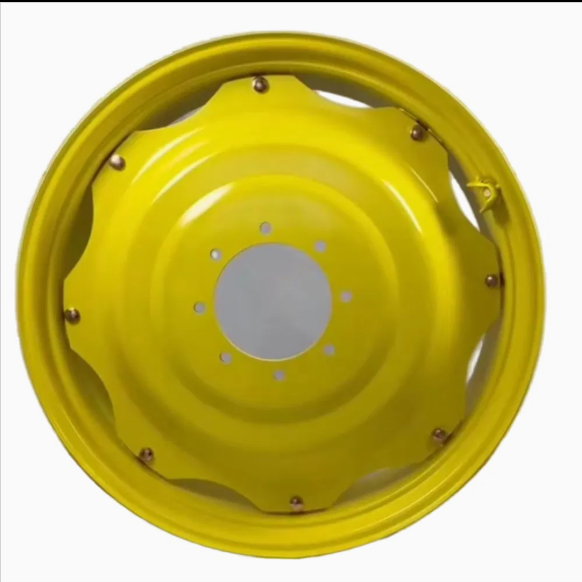
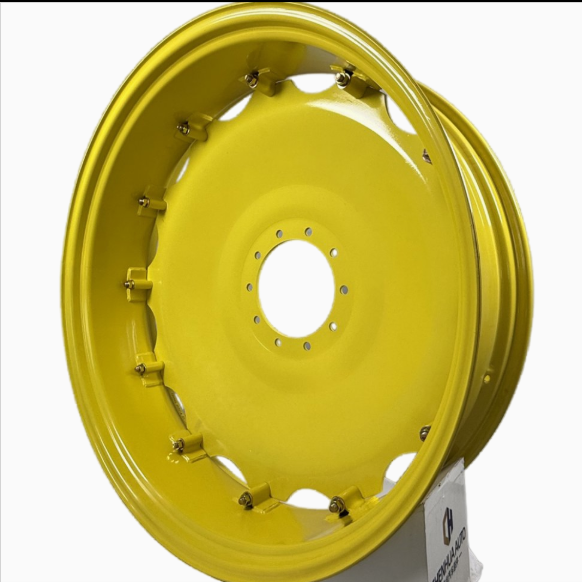
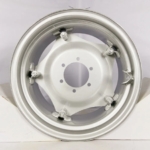
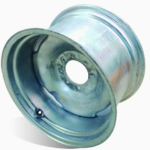
Combine harvesters are not a uniform platform. Axle flange dimensions, PCD, and required offset shift across manufacturers, model years, and even tire size selections on the same machine. A rim that is welded to a fixed offset forces a dealer or fleet operator to carry multiple SKUs for what looks like a single application. This W8×48 rim uses a bolted flange interface between the rim barrel and the center disc, enabling offset adjustment and axle-pattern customization while maintaining a structural connection designed for the cyclic torque environment of harvester drivelines.
Key Engineering Advantages
Flange connection engineered for cyclic torque, not just static load. The rim-to-disc joint on a harvester wheel is subjected to repeated high-torque impulses during threshing, unloading, and road transport at speed. A bolted flange concentrates stress at the fastener interface; if the flange geometry and fastener specification are not matched to that load profile, the joint becomes the first point of loosening or fatigue. This rim’s flange interface is machined to maintain clamp force across the contact face, and the fastener pattern is specified for the torque range typical of 9.5-48 and 11.2-48 tire applications on combine platforms. The design premise is the same one that governs flange-type rims in harsh agricultural and forestry conditions: a closely connected rim-spoke structure that withstands high torque and impact without deformation.
Offset adjustability as a fleet-standardization tool, not a convenience feature. The bolted flange allows the rim’s offset to be changed by repositioning the center disc relative to the barrel. For a dealership, that means one rim line can cover multiple harvester models or track-width settings that would otherwise require separate part numbers. For a large farming operation running mixed equipment, it means fewer spare rims held in inventory and faster swap times when a machine needs to move from transport width to field width. Industry descriptions of bolt-seat agricultural rims frame the advantage in exactly these terms: flexible adjustment of offset so machinery adapts to varying conditions, improving operational efficiency.
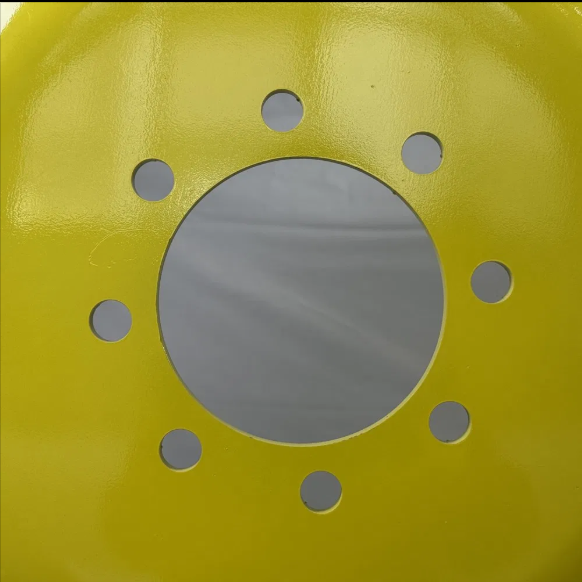
Customization grounded in fitment data, not guesswork. “Customizable” only has value if the customization is dimensionally controlled. This rim is offered against defined PCD and center-bore options (including common 8-bolt patterns in the 275 mm PCD range and 6-bolt patterns in the 205 mm range, with center bores in the 161–221 mm band), and the offset is set according to the harvester axle and tire combination specified at order. The customization process is a configuration against known axle interfaces, not a one-off fabrication exercise.
Fatigue margin as the specification that matters after the first season. Wheel failures in agricultural service are overwhelmingly fatigue-driven rather than single-overload events; studies of steel wheel failures consistently find that the majority of service failures are related to fatigue rather than pure strength insufficiency. For a harvester rim, that means the relevant question is not “will it hold the static load” but “will the flange joint and barrel retain their geometry after a harvest season of cyclic loading, vibration, and road transport.” The material specification and flange machining on this rim are selected around that longer-term failure mode, not just the load at the moment of installation.
Fitment Notes
Tire size pairing: This W8×48 rim is dimensionally matched to 9.5-48 and 11.2-48 tire sizes. Confirm the tire’s required rim width and bead profile before ordering; W-profile rims are not interchangeable with DW-profile tires without verification.
Flange fastener torque: The flange fasteners must be torqued to specification and re-checked after the first operating period. Under-torquing is the primary contributor to joint loosening and subsequent runout on bolted-flange rims.
Load rating verification: For harvesters operating with full grain tanks or on road transport at speed, verify the rim’s rated load capacity against the maximum axle load, not the empty machine weight.
Best Suited For
Combine harvesters and self-propelled forage harvesters requiring 48-inch rims for 9.5-48 or 11.2-48 tires, particularly where a single rim line needs to cover multiple axle configurations or offset requirements.Specifications
Size: W8×48 / Profile: W / Tire compatibility: 9.5-48, 11.2-48 / Construction: Bolted flange (rim barrel to center disc) / PCD options: Common 6-bolt (205 mm range) and 8-bolt (275 mm range) patterns, confirm at order / Center bore options: 161–221 mm range, confirm at order / Offset: Configurable via flange position / Finish: Industrial coating (custom colors available)
W8x48 Customizable Harvester Rim | Adjustable Flange, 9.5-48 Tire Fitment | Agriovrim
$200.00
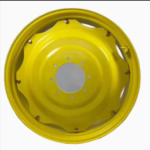
Bolt-on scalloped disc design with adjustable offset and track width for flexible row-crop positioning. Heavy-gauge steel construction with a durable yellow painted finish.It has a precision center bolt circle.It is built for high load capacity on large agricultural tractors.



Reviews
There are no reviews yet.